James Miller
Chinook Writer
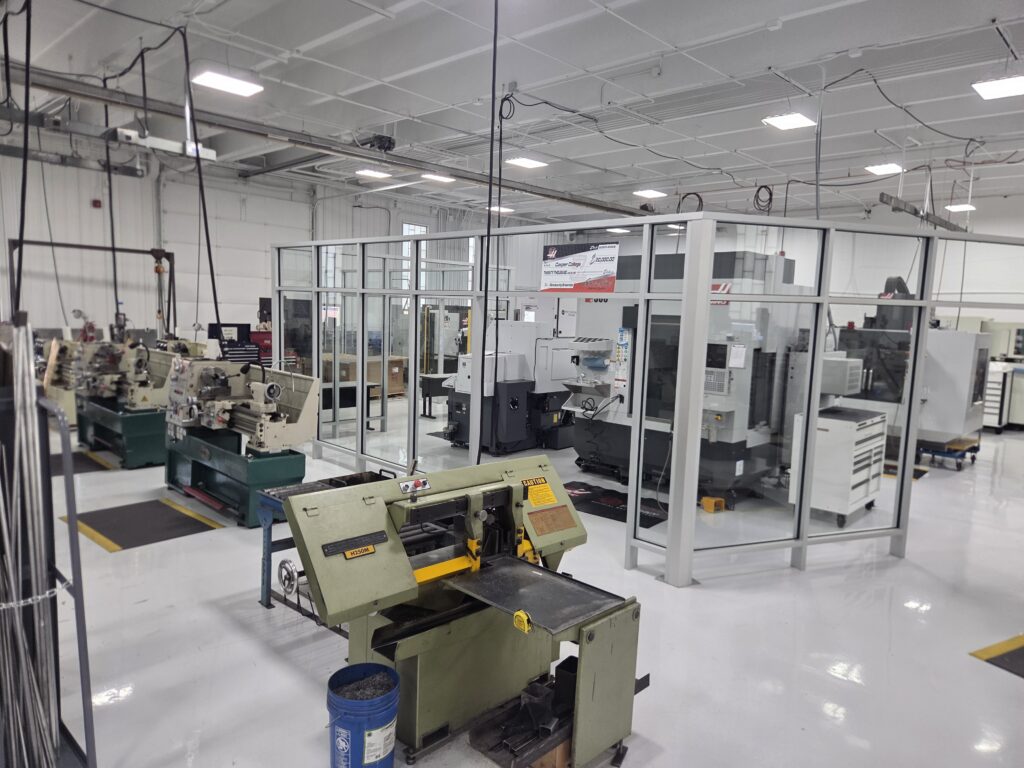
The Werner Technical Center at Casper College features a mix of older and newer machines to ensure students can use both no matter where they may work in the future.
Each respective teacher at the Werner Technical Center at Casper College works together to set students up for success after college.
Paul Brutsman, an engineering technology and design instructor, shared his thoughts on the programs offered at CC.
He said, “We have good machines, all of our equipment is up to date, and our instructors all have industry experience. I would guess the average is 15 to 30 plus years of experience before they came teaching, and I think that’s a very important thing.”
Brutsman himself brings industry experience to his instructor role.
Mark McCool, a machine tool technology instructor, spoke about his approach to teaching machining in regards to following project specifications. He spoke on how he teaches his students to become more precise in their projects until reaching the industry standard. “We start with some pretty simple stuff, some fractional tolerances which means it’s a little bit bigger. We gradually crawl, we walk, and then we run. We try to get things a little bit closer every project we work on,” McCool said.
McCool claimed that machining is in high demand and many shops as far as New Mexico give job offers to his students. Brutsman shared a similar piece of information regarding the current machining industry.
“There was a gap when all this manufacturing went overseas, so nobody trained on them. Nobody went into that field, and then we found out that’s actually not the case. They’re reshoring a bunch because they’re starting to find out the disadvantages of having everything built somewhere else in terms of quality and being able to control things,” Brutsman said. “Because there was that void of about 10 years when nobody really went into it, now we’re trying to catch up on the demand.”
McCool said the shop offers a mix of older and newer machines to ensure students can use both and hopefully prepare students for any shop they might find work. Brutsman said there are two main paths for a student in the machining program at CC.
“There’s a certificate in the degree as with almost all of our trade programs, which is nine months,” said Brutsman, “Or you can get a degree which is a year and nine months.” Brutsman expanded upon the benefits of either avenue.
“Certificates are a good option for some people that can only afford nine months, and they have to be in the workforce. But, I tell them if you can, get the AAS (Associates in Applied Science) because if you decide that you want to move into some type of supervisor or management position, oftentimes you’re required to have a degree,” Brutsman said.
The Werner Tech building holds multiple industry classes outside of machining, including welding and auto body repair. Occasionally, the classes will work together on a collective project, such as a firetruck that both the welding and autobody students worked on.
Marvin Aragon, a welding instructor, shared more information on this project.
“We pretty much took out the whole water assembly on the back end and re-fabbed the entire back half of the fire truck. Then what we did was we installed a lift in there. It’s going to be used for a funeral service,” said Aragon.
Aragon expanded on the different classes working together at the Werner Tech building. He said, “We work pretty closely with them. So if auto body or machine tool needs something welded, typically they’ll bring it over to the weld shop, and I’ll use that opportunity to show everyone at once how you would fix this certain thing just because the material might be a little different than what we’ve seen before.”
Aragon talked about what students can expect from the welding program at CC. “I have everything that the students will need. The only thing that the students will have to provide for themselves is their own PPE (Personal Protective Equipment). Select safety glasses, welding helmet, welding clothes, and boots. Typically when I get first time students, I’ll give them a tool list, and then we’ll work through that list together,” said Aragon.
Emil Williams, an auto body instructor, shared information on the auto body programs at Werner Tech, as well and how they merge with other programs. One focus of auto body is paint, and there is a painting room connected to the shop that Williams said the college added around a decade ago. Williams said the welding program helps out with the auto body projects by completing much of the welding that may be required.
All instructors at the Werner Tech building felt that they were heard by the college administration and felt that their concerns would be attended to in the scenario that any equipment were to break. They all adamantly praised the administrators and claimed to not have any issues with equipment or tools being replaced. Equipment for all departments must stay up to date and be relevant which can create the need for new equipment frequently.
“Our Dean, Rachel Chadderdon, is very good about if we have something that’s affecting the students like the machine’s down, so the students can get the knowledge that they need,” said Brutsman. “We’ve never had to just sit with the machine broke because we can’t fix it.”
Brutsman said that while there are plans for a new Werner Tech building, it will be years into the future and nothing is official yet.